
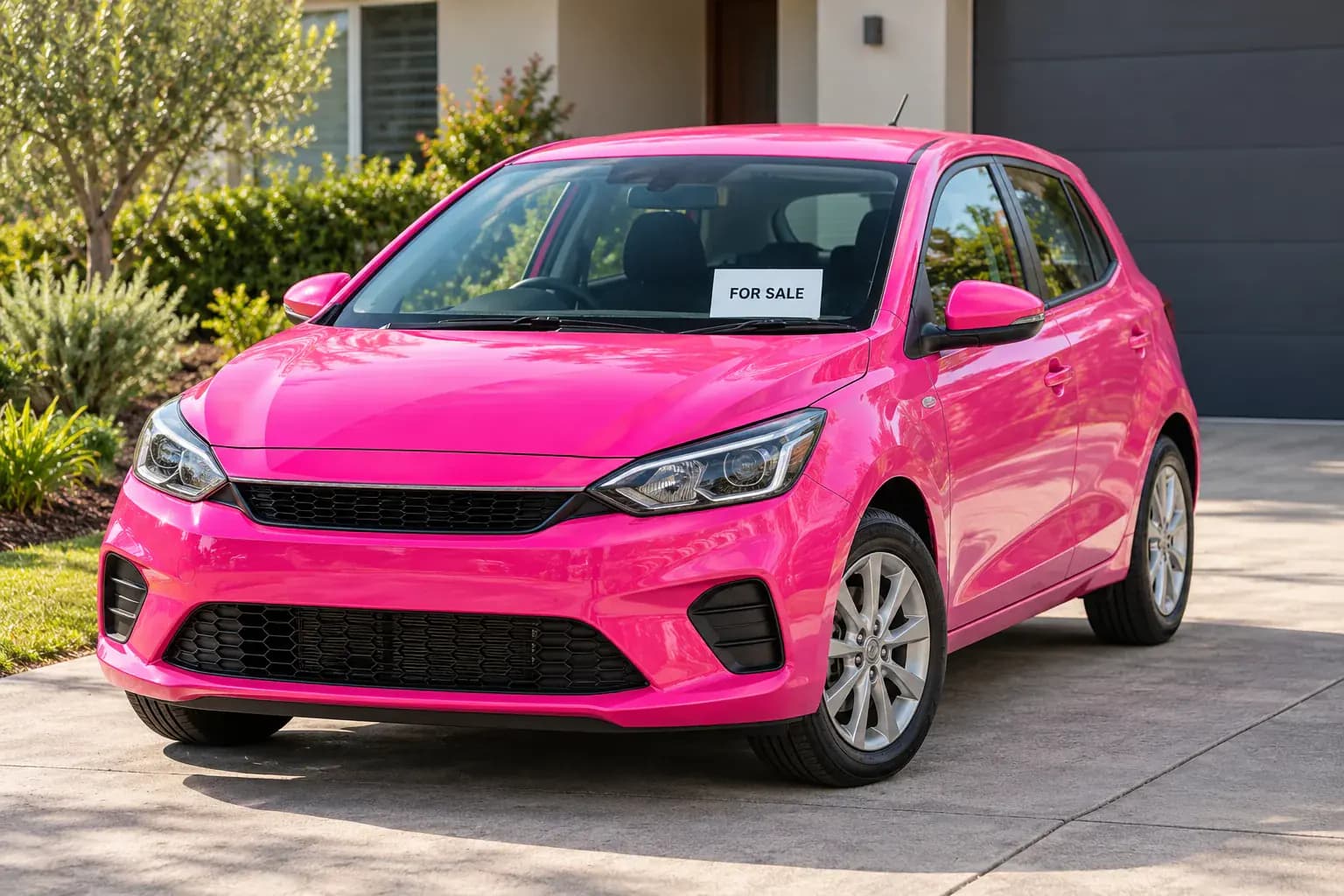
Choose a bright car and someone will probably mention resale value. Will an unusual colour make it harder to sell, or could it help the right buyer find it?
The familiar advice is to choose neutral paint to protect the car's value. The available evidence does not support treating that as a universal rule.
This article looks at the used-car evidence. For the separate question of why neutral paint fills so many new-car lots, read Why are so many new cars grey, white or black?.
What happened to more than 1.2 million used cars?
Automotive research company iSeeCars compared more than 1.2 million model-year 2022 used vehicles listed between August 2024 and May 2025. It adjusted each vehicle's original recommended price for inflation, compared that figure with its used listing price and grouped the results by colour and body style.
Across the whole dataset, the average vehicle had lost 31 percent of its value after three years. The three lowest average depreciation rates belonged to distinctly non-neutral colours:
- Yellow: 24.0 percent
- Orange: 24.4 percent
- Green: 26.3 percent
Grey vehicles lost an average of 30.5 percent. Black vehicles lost 31.9 percent and white vehicles 32.1 percent.
Explore the full iSeeCars colour and depreciation study
At face value, that result turns the usual advice upside down. The rare colours did not merely avoid a resale penalty; they retained a greater proportion of their original value.
But “yellow cars are always a better investment” would be just as misleading as “neutral cars always resell better.”
Rarity can work in both directions
A common colour has a large pool of potential buyers. It also has a large pool of competing sellers. If a shopper wants a three-year-old white SUV, there may be many similar examples nearby. That makes it easy to compare prices and choose the cheapest acceptable one.
A yellow, orange or green vehicle appeals to fewer people, but there are also far fewer examples available. When the number of interested buyers is stronger than the tiny supply, rarity can support the price.
This is the interpretation offered by iSeeCars. It is plausible, but it is not a controlled experiment. Bright paint may also be linked with limited editions, performance versions, desirable trim levels or models whose owners behave differently. Colour does not operate in isolation.
The type of vehicle changes the answer
The segment results are a useful warning against sweeping conclusions.
Orange and green performed particularly well among pickup trucks in the study. Orange, green and yellow led the SUV results. Yellow and orange also performed strongly among coupes and convertibles, where buyers may already expect a more expressive vehicle.
Green tells a different story among sedans. Green sedans lost an average of 33.8 percent, compared with a sedan average of 29.9 percent. The same colour that ranked third across the overall market ranked near the bottom in that particular segment.
This is why a broad colour ranking cannot predict the value of a specific car. Body style, model, trim, condition, mileage, location and the exact shade all influence what a future buyer is willing to pay.
What the evidence cannot tell us
The iSeeCars figures are based on US listings, expressed in US dollars. They are not completed Australian sales and should not be presented as a forecast for an individual vehicle here.
The study uses advertised used prices rather than the final amount paid. Its comparison is observational, so it can identify a relationship between colour and depreciation but cannot prove that the paint itself caused the difference.
The iSeeCars publication is industry research rather than an independent academic study. Its methods, scope and commercial context matter when interpreting the findings.
Most importantly, resale value changes over time. A rare colour can become sought after, remain unpopular or be overwhelmed by larger changes in the model's reliability and reputation.
A better way to choose
If resale matters to you, look beyond a generic rule about neutral paint:
- Check the exact model. Search local used listings and completed auction results where available. A green SUV and a green sedan may behave very differently.
- Consider supply as well as popularity. A colour does not need universal appeal if only a small number of buyers are competing for a smaller number of cars.
- Separate factory paint from later modifications. A documented factory colour, a professional removable wrap and a poor-quality repaint do not carry the same implications.
- Think about how long you will own it. Years of enjoying the car have value too. A speculative resale difference should not automatically overrule every day of ownership.
- Choose deliberately. If you genuinely prefer white, black or grey, choose it. If you love the green car, do not let an unsupported slogan make the decision for you.
Choose with better information
The findings challenge the idea that neutral paint always protects resale value. They do not establish a guaranteed financial advantage for bright cars.
Some colourful vehicles may benefit from a small supply and interested buyers. The result depends on the car, the colour and the local market.
Choose a colour you enjoy, then judge any resale claim against evidence for the vehicle you actually plan to buy.
Sources
- iSeeCars, The Best and Worst Car Colours for Resale Value, analysing more than 1.2 million model-year 2022 used vehicles listed from August 2024 through May 2025.
Source checked 15 October 2026.

Join the conversation
Keep it constructive, curious and kind. Comments are moderated before appearing.
No published comments yet. Start the conversation.